
Weekend Reads (July 25, 2026): “Calvin and Hobbes,” World Cup 2026, “Dirty Pair,” Charlie Kirk
Recommended weekend reading material for July 25, 2026.

Every week, I compile a list of articles in order to give subscribers like you something interesting and thought-provoking to read over the weekend. Note: If you’re a paying subscriber, then I hope you’re enjoying this month’s playlist and podcast episode.
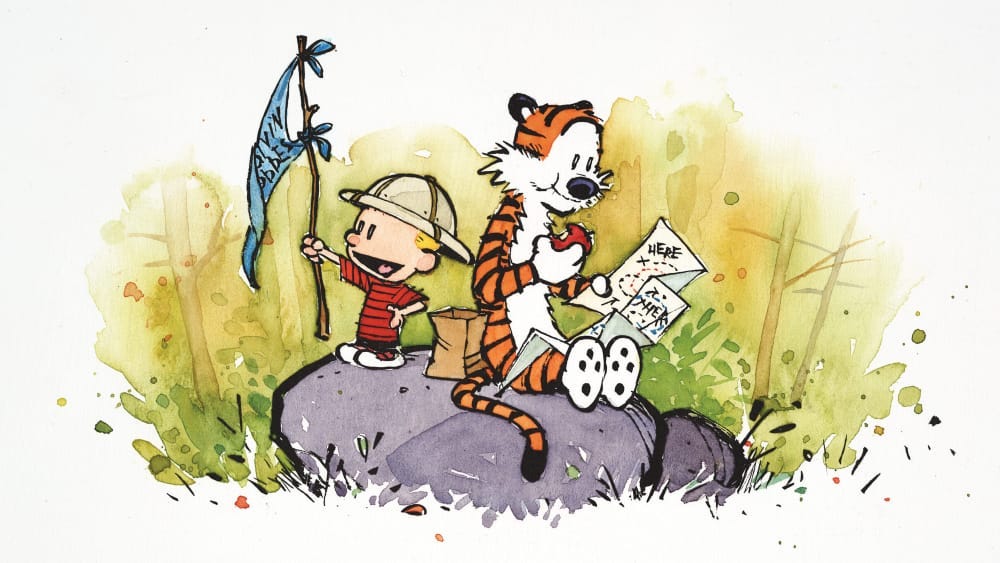
Daniel Sipes tackles that age-old question: Why is Calvin and Hobbes so magical even after all this time?
What is the magic of Calvin and Hobbes? It’s a very specific feeling, one that I remember from when I was a child and still feel — though perhaps not as strongly — whenever I pick up a collection now. Whenever a grown-up arrives and Hobbes turns into a limp, expressionless doll, you feel a twinge of sadness. Holding a doll, Calvin is a tragic figure: isolated, lonely, unwilling to enter the real world. But then the grown-up leaves. Hobbes becomes his witty, energetic, alive self again, and Calvin doesn’t seem so tragic anymore. Not with a friend by his side.
Related: Steven D. Greydanus examines how Bill Watterson was able to create a delightful strip without a single word of dialog whatsoever, and drives home the fact that Watterson was an artistic genius.
Cartoons have had more than their share of controversy over the years, and Joe Foley picks some of the most offensive of all time. Like, say, The Flintstones.
The first seasons were sponsored by R.J. Reynolds Tobacco Company’s Winston cigarettes and even saw Fred and Barney smoking and directly promoting the brand. While tobacco advertising was prevalent at the time, it seems shocking today to see such in-show advertising in a program that was likely to appeal to kids. Winston pulled its sponsorship in 1962 when it became impossible to deny that the series had a large family audience.
Rory Kiberd dives deep into the psychology of Hayao Miyazaki’s masterful Spirited Away, which turned 25 earlier this month.
Childhood is a period of adventure and spontaneity but also of intense absorption. That work of taking things in never really ends. This is why the best children’s films, like Spirited Away, are also for adults: like dreams, they give breathing space to mystery and inchoate emotions, allowing us to feel before we rush to explain.
Pixar’s latest title, Toy Story 5, currently stands poised to rake in over $1 billion in box office earnings. Nevertheless, the studio has been hit hard by company-wide layoffs implemented by Disney CEO Josh D’Amaro.
According to The Hollywood Reporter, the cuts will affect corporate functions, ESPN, Disney Entertainment Television, and the company’s film studios. Pixar is said to be facing the largest reductions among Disney’s film operations, although the number of positions being eliminated at the animation studio has not been disclosed.
This comes after a round of layoffs in 2024 when Pixar let hundreds of employees go.
Anthony Dabbundo lists the 29 best moments from the 2026 World Cup.
The theme of the 2026 version was new horizons. An expanded 48-team field. The first World Cup with three host nations. Hydration breaks. Halftime shows. A round of 32. FIFA bet that we’d all enjoy more games and more teams, and they were correct. We reveled in the great underdogs that barked through the group stage. We embraced the superstars that shined brighter than ever at the top of the game. We debated controversies. We watched our World Cup heroes of old fall, and learned who the new heroes will be.
Related: Over on Christ and Pop Culture, I shared some of my favorite World Cup moments, both on and off the pitch.
The Inverse staff share their picks for the best sci-fi movies and TV series of the year (so far).
Conspiracy theories, class conflict, fears of an AI apocalypse — these aren’t just trending topics, but vital themes in some of the most prescient and entertaining sci-fi storytelling of today. You’ll get all of this, plus nostalgia trips, revenge plots, interstellar friendship, and a rainbow of multicolored goo, on our list of the best the genre has to offer in 2026 so far.
Prior to Pol Pot’s communist regime, Cambodia had a rich and vibrant musical culture as seen by the era’s richly colorful cover art.
What strikes me most about these restored album covers is the vivaciousness of the period portrayed through color and typography. The structure of the Khmer script rarely calls for spaces, creating long, bold shapes all on their own. While we’ll come across some French influence, the majority share vibrant, bright color palettes that date back to early Cambodian history.
Related: Hollywood’s movie posters have got nothing — and I mean nothing — on Ghanian movie posters.
Jeff Terich offers up a beginner’s guide to the music of David Eugene Edwards of Wovenhand and 16 Horsepower fame.
A prolific artist with a history in bands dating as far back as the ’80s, Edwards has a deep catalog of music with his two best-known outlets, the influential gothic-country band 16 Horsepower and his long-running, shape-shifting project Wovenhand, in addition to records he’s released under his own name. Yet while his sound has evolved over time, blending a foundation of traditional American folk music with gospel, post-punk and alt-country, it invariably carries a singular darkness, paired with a deep sense of spirituality. The grandson of a Nazarene preacher, that background, along with his own faith, has heavily informed his songwriting — though he admits to having never liked contemporary Christian music (and “CCM” audiences never particularly liked his music either).
I was fortunate enough to see Wovenhand perform at the 2002 Cornerstone festival, where Edwards and his bandmates delivered an utterly spellbinding performance.
My personal favorite Edwards recording is Wovenhand’s 2004 sophomore album, Consider the Birds. From my review: “In nearly every song, [Edwards] casts himself completely on the favor of a raging and unknowable God, using language that would not have been unfamiliar at all to David and the other psalmists.”
Back in 2021, a Kickstarter campaign was launched to create a new English dub of the classic ’80s anime series Dirty Pair. Despite raising over $700,000, the campaign has largely been a failure. Five years later, Coop Bicknell tries to figure out how it all went sideways.
Over the course of four long years, this highly anticipated release played witness to multiple production setbacks, a company sale, and ever-increasing pushback from backers whose patience had run dry. It didn’t help that the final product was plagued with quality control issues and the absence of promised features.
So, what was the holdup? I’d been asked to look into that question four months before the set’s surprise release. By working on more than a few home video releases, I’ve developed a basic understanding of what goes into the production process. Some take a bit while others are relatively snappy — it’s different in every situation. However, that situation drastically changes when 3,303 Kickstarter backers have put their money on the line.
New York sculptor Sergio Furnari spent $100,000 making a life-sized statue of Far Right firebrand Charlie Kirk that nobody wants.
Furnari said he made the statue in an effort to “glorify and to exercise the first amendment, this freedom of speech” – although at points during the conversation, Furnari also said he made it to support Charlie Kirk’s wife; to “glorify democracy”; and to “commemorate a person”.
He later added: “Why am I making the statue? The same reason why Michelangelo did the Pietà, or Michelangelo did the David, or Leonardo da Vinci painted the Mona Lisa. Why? Just to commemorate a moment, you know, a person.”
It’s also clear, however, that Furnari, despite no one having commissioned him to make the statue, was hoping to make money. He said he had expected unnamed wealthy figures to donate to him — he spent $100,000 on steel, resin and labor — but that has not come to pass.
It’s been awhile since I’ve taken an art history class, but I’m pretty sure that Michelangelo and Leonardo da Vinci made those iconic works of art not so much to “commemorate a moment,” but rather, because someone actually paid them to do so.
This post is available to everyone (so feel free to share it). However, paying subscribers also get access to exclusives including playlists, podcasts, and sneak previews. If you’d like to receive those exclusives — and support my writing on Opus — then become a paid subscriber today for just $5/month or $50/year.