
Weekend Reads (March 28): Chuck Norris (RIP), Spring 2026 Albums, Em Dashes, Iranian Propaganda
Recommended weekend reading material for March 28, 2026.

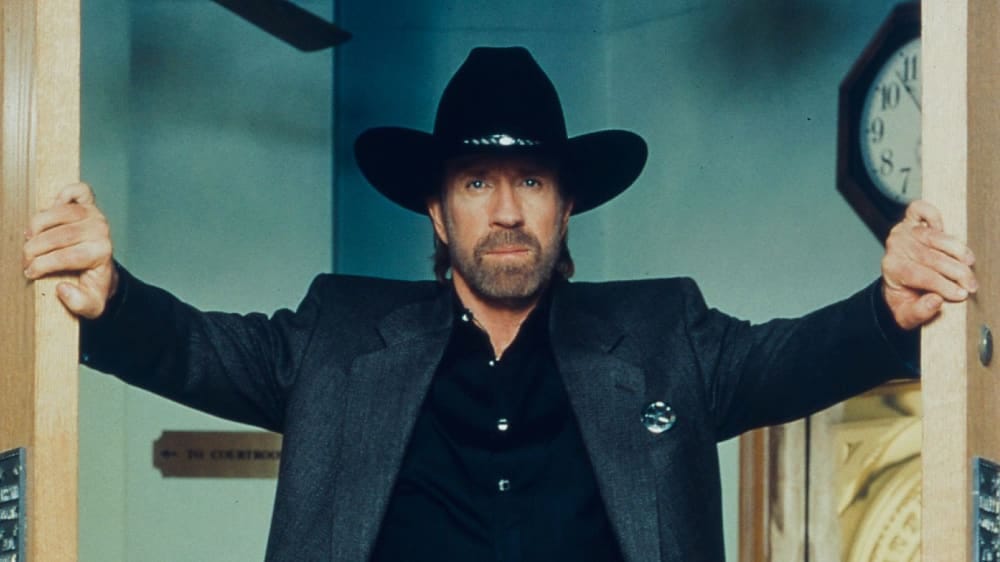
Martial arts superstar Chuck Norris died late last week at the age of 86.
Born Carlos Ray Norris on March 10, 1940, in Ryan, Oklahoma, Norris served in the U.S. Air Force as a young man before dedicating himself to training in martial arts. During that time, he developed a friendship with martial arts icon Bruce Lee and moved to Hollywood to train film stars in combat. He later moved in front of the camera and began one of the great action movie star careers.
Related: Norris’s fellow action stars, including Arnold Schwarzenegger and Jean-Claude Van Damme, paid their respects.
Also related: I have a fondness for Chuck Norris films from the ’80s like The Octagon and Lone Wolf McQuade, so I posted my own tribute to Norris. I wrote about his 50+ years’ worth of films and TV and his legacy of internet jokes, as well as his right-wing politics, which have caused some to celebrate his death.
The Pitchfork staff have shared their picks for Spring 2026’s most anticipated albums, including new releases from longtime Opus faves American Football, Björk, Broken Social Scene, Massive Attack, and Seefeel.
Related: Some of those artists also appear in Pitchfork’s most anticipated tours of Spring 2026.
Talk about a treasure trove: Some kind soul scanned and uploaded more than 350 issues of the British music magazine NME from 1969 to 1983. The earliest issue, dated January 4, 1969, features coverage of The Animals, The Foundations, and some no-name band called the Beatles.
Via Kottke.
Celebrated comic creator Sam Kieth, who co-created The Sandman with Neil Gaiman, died of Lewy Body Dementia two weeks ago. He was 63 years old.
Born on January 11, 1963, Kieth began his career in comics at the age of 17, publishing his first work with Comico. He worked on numerous projects, including Wolverine in Marvel Comics Presents and The Hulk. In 1993, he created a series exploring themes of identity and reality for Image Comics titled The Maxx, which was later adapted into an animated series for MTV’s Liquid Television and became globally recognized. Kieth’s work on the series also led to a line of action figures produced by Todd McFarlane.
Kieth’s other works include Zero Girl, Batman: Secrets, Judge Dredd, and 30 Days of Night.
I didn’t read many of Kieth’s comics back in the day but I did watch The Maxx on Liquid Television, and was fascinated by its story about a superhero who jumps back and forth between the real world and a primeval alternate reality while protecting a young woman. That description, however, only scratches the surface of the series’ bizarre-ness.
An upcoming horror novel titled Shy Girl was recently pulled by its publisher after numerous investigations raised suspicions that it was largely written with AI.
In January 2026, someone claiming to be a long-time book editor posted a long Reddit thread claiming that the novel had all the hallmarks of AI lit. “If so, I find it repulsive that it has been picked up and published by the second largest publishing company, at least in the UK,” said the Reddit post. “If it isn’t AI, she’s a terrible writer. Her writing is truly indistinguishable from an LLM.”
The writer, Mia Ballard, claims that the book’s editor might’ve used AI. However, sci-fi author John Scalzi dismisses her excuse: “I reread reach my novels a dozen times during the pre-pub process, this excuse is bunk.”
Jeffrey Zeldman defends the humble em dash, which has largely become flagged as a tell-tale sign of AI.
The irony — and it’s a major irony — is that real writers use em-dash frequently, and for reasons. As a written signifier of verbal speech pauses, it means something different than what commas and semicolons mean. It connects while separating.
That’s why so many writers use em-dash when it is the best mark for the job. In turn, chatbots use it because they were schooled on millions of writers.
You can have my em dashes when you pry them from my cold, dead hands — and not a second before that.
Thanks to social media, marketing, and manosphere trends like “looksmaxxing,” Gen Z is going to great lengths to quantify human beauty.
A generation obsessed with looks is nothing new, but in the age of algorithms, the very concept of beauty is being drastically redefined. Qualities such as presence, charisma, and sex appeal hold little currency online, where the unnameable has always struggled to exist. A person’s je ne sais quoi, once the spark that made skin tingle and hearts leap, has been replaced by scientific language and mathematical precision that reads, to the uninitiated, like gospel. The canthal tilt and orbital depth of someone’s eyes, the angles of their cheekbones, the ratio between forehead and hairline, even tongue posture — these are just a few of new variables this generation has been trained to evaluate when they see a photo or encounter someone’s profile.
Earlier this week, iconic civil rights leader Cesar Chavez was revealed to have been a sexual predator. Sadly, this isn’t the first time that a celebrated leader turned out to be a terrible human being, and it won’t be the last. (See also Jean Vanier, Bill Cosby, and Ravi Zacharias.) Steven Greydanus writes about what happens when our heroes become villains, and what it means to be a person of integrity.
The virtue of integrity, then, is the virtue connecting and uniting all the various parts of a person in a single cohesive, harmonious unity. To be a person of integrity means to be, amid all one’s various social selves, the same moral person. It means not compartmentalizing what is morally licit in the various spheres of our lives; living without duplicity or other forms of inner contradiction. To aspire to integrity means that even though people at work, at church, at home, and in other contexts may see very different sides of you, all of these sides or parts of you should be integrated in a way that has a stable soundness.
Related: The questions that Greydanus asks in his thoughtful piece were very similar to the questions that I asked upon hearing about Philip Yancey’s years-long affair. “[I]t hurts when someone you looked up to as a mentor and exemplar of the sort of life you hope to live fails to hold to the standards they profess.”
In addition to the physical war currently happening in Iran, with bombs and missiles, there’s also a propaganda war being waged online between Iran and the USA. And as far as Matthew Gault can tell, Iran is winning the propaganda war.
To be clear, it speaks to how bad things are online that we need to analyze whose AI disinformation and propaganda is “better,” and, in general, the slopification of the internet has been a disaster. And yet, the stuff Iran is making is resonating and spreading online in a way that Trump’s slop is not. We do not know who, specifically, is making the Iranian AI slop or which tools they are using to make it. But the fact that Iranian AI slop is resonating with Americans while American slop is not should perhaps not be surprising; for the last several years, the most successful purveyors of AI slop have largely been based in foreign countries, where they have been incentivized to make content that specifically targets American audiences because of the way that social media ad rates work. Because of that, an entire economy has emerged in which people who would otherwise have little interest in reaching American audiences have been incentivized to study what resonates with Americans on the internet and have created entire businesses focused on teaching other people what Americans care about and how to target them with AI slop.
This post is available to everyone (so feel free to share it). However, paying subscribers also get access to exclusives including playlists, podcasts, and sneak previews. If you’d like to receive those exclusives — and support my writing on Opus — then become a paid subscriber today for just $5/month or $50/year.